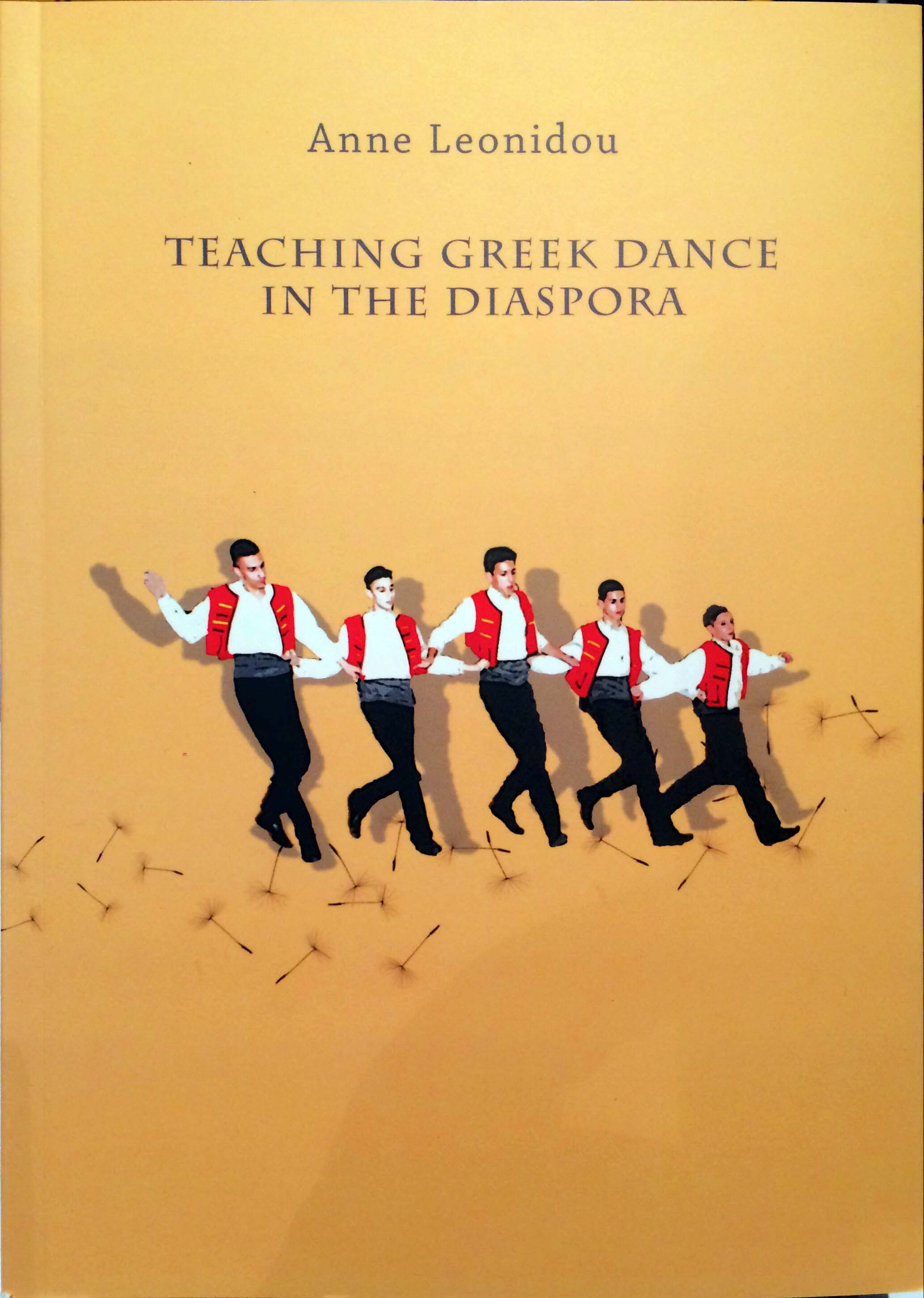
Anne Leonidou
TEACHING GREEK DANCE
IN THE DIASPORA
£15.00 + pp
Portrait of the Greek Dance
Research: Anne Leonidou
MA Greek Folk Dance Education
|Characteristics
| Regional Characteristics |
Epirus | Macedonia | Thrace
| Thessaly
| Roumeli | Peloponnese | Aegean
Islands | Dodecanese |
Ionian
Islands | Crete |
| Cyprus | Pontus
| Cappadocia |
Constantinople | Smyrna |
Introduction
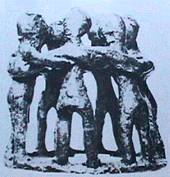
Greece is one of the few countries in the world where folk dances are as alive today as they were in ancient times. Dance has always played an important role in the life of a Greek. It is an expression of human feelings and everyday life. The Greeks danced at religious festivals, ceremonies; they danced to ensure fertility; to prepare for war and to celebrate victories; they danced at weddings; to overcome depression and to cure physical illness. Almost every dance has a story to tell. Dance was regarded as one of the highest forms of art. Plato agreed with his mentor Socrates that every educated man should know how to dance gracefully by which he meant the manly exercises that kept the body strong and supple and ready to do its duty on the battlefield. The Pyrrhic, or weapon dance (a form of mock combat) taken from Crete and perfected in Sparta, was the ideal.
The dance, of all the arts, is the one that most influences the soul. Dancing is divine in its nature and is the gift of the gods. Plato
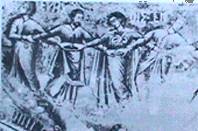
| Traditional dance continues to be passed from generation to generation, which in turns maintains national identity. Folklore is the term used for traditional dance when performed out of its traditional social context. The principal characteristic of folklore dance is that it is not transmitted in a traditional manner but by a process involving dance teachers and gym instructors. | 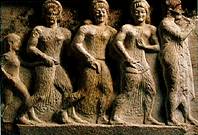 6th century B.C. |
There are two distinct categories in the traditional Greek dance; the springing/leaping dance and the shuffle/dragging dance known as sirtos; the latter being the oldest form of dance. Most dances are circle dances, start with the right foot and move counter-clockwise. Each dancer is linked by a handkerchief or by holding hands, wrists or shoulders. In mixed dances, the man will lead the dance, which allows him in most regions to improvise or break away allowing him to express himself. Until recently, men and women rarely danced together although chains of men and women danced together at the same time, the women in the inner circle and the men in the outer circle. The order of dance varies from region to region. In general, the men are commonly at the beginning in descending order of age, followed by the women also ranked according to seniority. Sometimes the married men come before the bachelors and likewise for the women. The oldest inhabitant always leads the dance. In the islands the circle is usually formed of groups of families, the husband leads the wife who is followed by the eldest son, his wife and their children etc. Occasionally the local priest will lead the first dance symbolising a blessing. In olden times a man never held a woman’s hand but a kerchief. This also applied to married couples. In some regions a woman could not dance next to a man who was not family: therefore a child or an elderly would be placed in between. Most women's dances are slow, simple and dignified whereas the men’s dances often portray their manhood.
|
|
In ancient times, dance was held in high regard in particular for its educational properties. Dance was essential for developing personality as well as preparing for battle. Dance along with music, writing and physical exercise, was the basis of the educational system. In major cities/kingdoms of Ancient Greece, men were taught to dance. According to Athenaeus in Arcadia, the expenses were met from the civic purse and pupils staged an annual display of their accomplished skills which all citizens attended. |
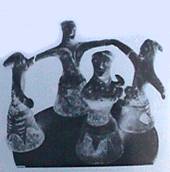
Lucien tells us that the Thessalians have such regard for dance that they name their eminent citizens pro-orchesteres or lead dancers.
Greece has 6 mainland regions: Epirus, Macedonia, Thrace, Thessaly, Central Greece and Peloponnesus. In addition, the Greek islands fall into the following categories. The Ionian islands between Greece and Italy which includes the island of Kithira south of Peloponnese, the Saronic islands near Athens, Cyclades occupying the central Aegean Sea, the North Aegean islands close to the West coast of Turkey, the Dodecanese islands, occupying the southeast of the Aegean, between Crete and Turkey, the Sporades which are a small cluster of islands near the island of Euboea, and Crete, the largest island which lies in the southern part of the Aegean Sea.
|
Although Cyprus is an independent country, it is however the largest island inhabited by Greeks and falls within the Greek major cultural regions. Furthermore, the peninsula in western Asia between the Black Sea, Aegean Sea and Mediterranean Sea historically referred to as Asia Minor which is separated from Europe by the Bosporus, the Sea of Marmara (Propondis) and the Aegean Sea was previously inhabited by Greeks since ancient times but the majority have found refuge in Greece following the Asia Minor Disaster and the burning of Smyrni in 1922, the population exchange in 1923 and more recently, the deportation of Polites (Greeks of Constantinople) during the Cyprus troubles. Generally, Asia Minor dances are divided into four groups; Pontus, Cappadocia, the Coastal Regions and the urban centres of Constantinople and Smyrna. |
|

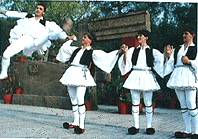 |
Epirus lies between the Pindus Mountains and the Ionian Sea. It was formally united with Greece in 1913 although Northern Epirus became part of the new state of Albania. It is especially rich in folk music. It’s rugged, mountainous and the steep gorges impose heavy garments and boots. A unique characteristic of the region is the polyphonic singing. Dances from Epirus tend to be slow, heavy and danced with immense dignity. Their main instrument is the clarinet. Dances of this area include Sta Tria, Pogonisios, Sta Dyo, Vasilo Arhontissa, Yiatros, Kalamatianos, Tsamikos, Zagorisios, Koftos, Fisouni, Kentimeni Podia, Berati and Fezodervenayas.
|
|
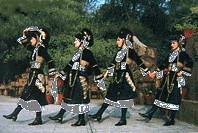
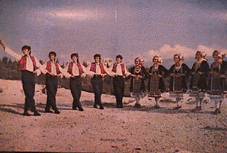
Macedonia was formally united with Greece in 1913. It stretches from the north east on the Aegean coast across to the North West to the Pindus Mountains. This mountainous area with small valleys has a particularly rich folk culture. The variety is to some extent due to its geographical position where it borders with the Balkan countries. The traditional band, the ‘ziyia’, is made up of two zournas and a daouli or one bagpipe (gaida) and one daouli. Dances of this area include Gaida, Beratis, Leventikos, Sta Tria, Akritikos, Baidouska, Kastorianos, Nizamikos, Syre Syre, Boimitsa, and Mikri Eleni. |
 |
 |
Thrace is sub-divided into three areas; Western Thrace which was united with Greece in 1923, Eastern Thrace which lies in present day Turkey and Bulgaria extending to the Black Sea and Marmara and Northern Thrace in the south east of Bulgaria as far as the Black Sea. Thrace is particularly rich in dancing with a wide variety of hand hold positions. Their dances are generally lively and energetic and tend to lack improvisation by the leader. The instruments common to this region are the bagpipe (gaida), tabor (drum) and the lyre. Dances from this area include Zonaradikos, Tsestos, Baintouska, Syngathistos, Stis Treis, Mantilatos and Xisyrtos. |
|
Thessaly was united with Greece in 1881. This is mainly fertile plains for farming. Their dances have parallels with those of Epirus. Thessaly retains a strong tradition of song-dances where the dancers sing the music, often without instrumental accompaniment. Instruments common to this region are the clarinet, violin, lute and defi (tambourine). The zournas and gaida were more common in the past especially in the areas bordering Macedonia. The dances are generally slow and dignified which include Sta Tria, Sta Dyo, Kalamatianos, Kleistos, Svarniara, Karagouna and Tai-Tai. |
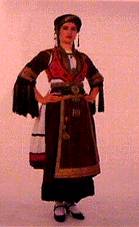 |
CENTRAL GREECE AND ROUMELI
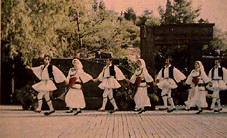 |
The area of central Greece is also referred to as Sterea Ellada or Roumeli. Roumelian dances have a tendency to be slow and controlled. The clarinet is the main instrument in this region and in older times, the zourna and daouli. The main dances of this region are Tsamikos, Kalamatianos, Sta Tria, Sta Dyo, Kleistos, Mazochtos and Kangeli. |
|
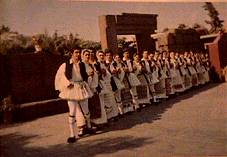
Peloponnesus also known as Morea is the cradle of modern Greece. It was here in 1821 that the struggle began to free Greece from the Ottoman rule and is the oldest part of modern Greece as we know it today. Instruments used are the violin, clarinet, lute and santouri. Their main dances are Kalamatianos, Tsamikos, Tsakonikos and Kariatidon. |
 |
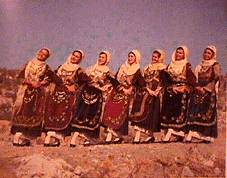 |
The music of these islands is very delightful and lyrical and as such portrayed in its dances. These are characterised by the lightness of steps and the springing in the knees. Most frequently danced are Ballos, Sirtos, Hasapikos, Karsilamas, Sousta, Trata, Stavrotos, Chiotikos and Ikariotikos. | |
| Saronic Islands |
The Saronic islands include Salamis, Aegina, Poros and Angistri. Dances of these islands include Syrtos, Ballos, Koulouriatikos and Trata. |
|
|
Cyclades
|
The name refers to the islands that encircle (κυκλός) the sacred island of Delos. The Cyclades islands include Amorgos, Delos, Kythnos, Mykonos, Naxos, Paros, Santorini, Serifos, Sifnos, Syros and Tinos. The music of these islands is very delightful and lyrical and as such portrayed in its dances characterised by the lightness of steps and the springing in the knees. Dances include Syrtos, Ballos, Sousta and Karsilamas. |
|
|
North Aegean
|
The North Aegean islands are a number of disconnected islands in the north Aegean Sea also known as the Northeast Aegean islands. These islands include Chios, Ikaria, Fourni, Lesvos and Samos. The music of these islands is very delightful and lyrical and as such portrayed in its dances. The main instruments are the violin, lute and the santouri and occasionally the oud. Dances include Syrtos, Ballos, Sousta, Tripatos Pyrgousikos, Ikariotikos Haniotikos, Lerikos and Karsilamas. |
|
|
Sporades |
The Sporades islands include Skiathos and Skopelos. Dances from these islands include Syrtos, Ballos, Sousta and Karsilamas. |
|
Dodecanese islands
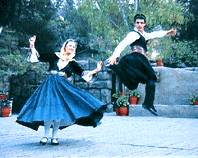 |
Dodecanese meaning the twelve islands include Rhodes, Kos, Patmos, Kalimnos, Karpathos, Leros, Nisyros and Tilos. These islands were under Italian rule between 1923 and 1944, then under British rule between 1944 and 1947. In 1948 they were finally reunited with Greece. They have a rich musical tradition and their dances were influenced by the Cretans who immigrated, fleeing from the Turks. This probably explains why their main instrument was the lyre. The violin became popular accompanied by the santouri and in some cases replaced the lyre although the lyre is now having a major comeback. Dances from this area include Syrtos, Ballos, Roditikos, Lerikos, Sirba, Haniotikos and Sousta. |
The Ionian Islands also known as Eptanisia, meaning the seven islands were reunited with Greece in1864. Their music was highly influenced by Italy with main instruments being the guitar, violin and lute and in recent times, the mandolin; with the exception of Lefkada where the traditional clarinet was popular due to the short distance which separated them from mainland Greece and in particular, Epirus. The people from Corfu are particularly musical and famous for their ‘kantades’. The dances are graceful, flirtatious and sometimes with swaying movement. Dances from these islands include Syrtos, Ballos, Ai Yiogis, Fourlana, Rouga, Korakianitikos,Thiakos and Tsirigotikos.
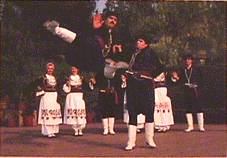 |
Crete is the largest Greek Island and the fifth largest in the Mediterranean. It was reunited with Greece in 1913. Throughout history, this race is renowned for its heroism and is reflected in their dances which are dynamic and fast. Each Cretan dance gives the opportunity for a dancer to lead and improvise. A particular characteristic of the Cretan dances is the springing movement of the dancers. The Cretan lyre is the most distinctive instrument on this island. Their dances include Syrtos, Siganos, Pentozalis, Maleviziotikos, Laziotikos, Rodo, Apanomeritis, Zervodexos and Sousta. |
Cyprus is an island in the far Mediterranean Sea with the majority of its inhabitants of Greek origin, language, culture and traditions (82%). Due to its strategic position in the Mediterranean, it was invaded by many nations, namely, the Assyrians, Persians, Romans, Arabs, Franks, Venetians and Turks. It was a British colony between 1878 and 1959 and finally became independent in 1960. Its music and dance are quite distinctive. Up until the middle of the 19th century, the typical instruments were the shepherd’s flute and a small tambour. Then the familiar bands of the islands consisting of the violin and the lute made their introduction into the urban centres finally making their way to the villages. Following the Asia Minor Fires, refugees settled in the urban areas bringing with them their songs which were embraced and modified by the Cypriot people. The Cypriot dances are firmly separated into men’s and women’s usually danced in pairs or separately; with the exception being the last part of the women’s Karsilamas which is danced in a circle. Their dances are Karsilamas, Syrtos, Zeimbekikos, Datcha and Drepani.
|
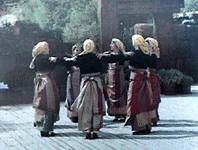
Pontus lies in the region of present day Turkey on the eastern Black Sea into Russia; an area inhabited by Greeks from ancient times until the population exchange in 1923. Pontiac music and dance are quite distinctive. Its music and dance is easily recognised by its nervous energy, their use of knee bends and unusual shoulder tremors, unique to Pontus. The Pontiac lyre is the most distinctive instrument. Other instruments include the angion (bagpipe) and the zournas. The dances of this area include Omal, Dipat, Tik, Kotsari, Kots, Trygona, Kotsari and Serra. |
 |
|
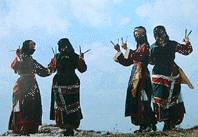
Cappadocia lies in present day central Turkey which was an important centre of Byzantium and the home to St Basil and St Gregory. It was one of the first areas to fall under the Ottoman Empire. The Cappadocians remained there until the population exchange in 1923. They have a tradition of ritual line dances closely associated with the church calendar, e.g. Ayio Vasiliatikos. The other well known dances are the Dance of the Scarves, the Spoons, Seïtata and Karsilamas. |
 |
Constantinople, the capital city of the Roman, Byzantine, Latin, and the Ottoman empires was founded in 324 AD at ancient Byzantium as the new capital of the Roman Empire by Constantine the Great, after whom it was named, and dedicated on 11 May 330. By 12th century the city was the largest and wealthiest European city. The fall of Constantinople in the historic battle of 1453 saw the beginning of the Ottoman Empire, now, present day Turkey. It remains the seat of the Patriarch of Constantinople. The music and dances from Constantinople have travelled all around the Greek world. It was here that the popular dance Hasapikos originated. Other dances include Syrtos, Ballos, Karsilamas and Zeimbekikos.
Smyrna was an important financial and cultural city up until its destruction by the Great Fire in1922. Many Greeks moved to Greece and the islands bringing with them their music and dances. Many well known melodies from the Greek islands originated from Smyrna. Dances include Syrtos, Ballos, Zeimbekikos, Karsilamas and Hasapikos.
Coastal Regions
The music of the coastal regions was largely influenced by Smyrna but also has strong island influences especially in Erythrea, Vithymia, Artaki, Aeolis, Aivali, Pergamos, Alatsata, Silivri and the island of Imvros
Copyright © 2000-2014 Nostos.com. All rights reserved.